
Contact Lenses
Different eyes call for different contacts, and we’ll find the ones that are right for you.
If you are already a contact wearer, then you know how convenient contacts are. If you don’t wear contacts and are thinking of trying them, you’ll probably discover that you love them too! They’re an amazing solution for people who don’t like wearing glasses or want hassle-free vision correction that allows you to wear non-prescription sun wear and goggles.
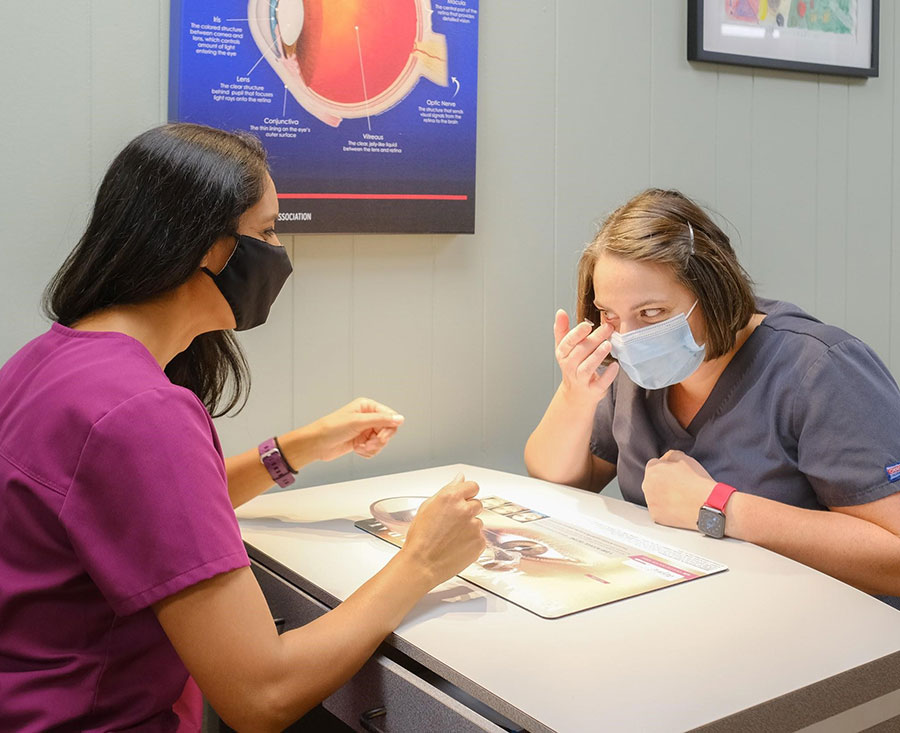
Contacts are an ever-evolving product, and there are lots of different types of them on the market. So when you come in for your contact lens fitting, our doctors will examine your eyes, then recommend the best option for you based on your prescription and overall eye health. After we order you a free trial, our staff will sit down with you and teach you how to insert, remove, and care for your new contacts.
Get An Idea Of The Different Contact Lens Options Available To You Below:
Soft Lenses
These lenses are known for how comfortable they are and must be replaced monthly, weekly or daily depending on the type. Soft lenses are often recommended for sports because they fit closer to the eye and are more difficult to dislodge. They can provide correction for most prescriptions including astigmatism. Today, most contacts are made with newer materials like silicone hydrogels, which allow more oxygen to the eye and patients find it easier than ever to wear soft lenses comfortably.
Gas-Permeable (GP) Lenses
Made of moderately flexible plastics, GP lenses offer sharp vision and correct most vision problems. They are more durable than soft contact lenses and can be easier to handle and care for, but they also take longer to get used to and need to be worn consistently to keep your eyes adapted to them.
Multifocal Lenses
In both soft and GP designs, multifocal lenses offer patients both distance and near vision correction just like a pair of bifocal glasses.
Scleral Contact Lenses
Scleral contact lenses are large contacts that rest on the sclera, the white of the eye, and create a tear-filled reservoir over the cornea. Scleral lenses are designed to treat a variety of eye conditions, many of which do not respond to other forms of treatment. Scleral contact lenses can be used to improve vision due to corneal irregularities such as Keratoconus, Pellucid Marginal Degeneration, Post Surgical Corneas, Trauma, Corneal Scars, and some corneal dystrophies/degenerations. Scleral lenses have also been successful in treating severe dry eyes.
Cosmetic and Prosthetic Tinted Contact Lenses
Prince William Eye Associates is now proud to offer custom and prosthetic tinted contact lenses. Prosthetic contact lenses mask flaws and improve the appearance of an eye that has been disfigured from birth, trauma, or an eye disease. Prosthetic lenses can be specially designed to match the appearance of the other normal eye. At Prince William Eye Associates, we have the BioColors fitting set that is used to match iris color and pupil shape as closely as possible. This will make the disfigured eye less conspicuous.
These prosthetic lenses can also help patients looking to reduce distorted vision, light or glare from entering a damaged eye. Prosthetic lenses can be made with opaque pupils or smaller pupils. People with incomplete formation of the pupil (aniridia), post surgical iris abnormalities, lack of pigment (albinism) or damage to the cornea from trauma can be successfully treated with prosthetic lenses.